

American Association of Oral and Maxillofacial Surgeons Oral and maxillofacial surgeons:
The experts in face, mouth and jaw surgery®

The No Surprises Act (NSA) introduced a two-part process to address and resolve disputes over out-of-network reimbursement between providers and payers. Since the creation of the NSA in 2022, the guidance and operations of these processes have expanded. This resource is designed to help OMSs and their staff navigate the federal arbitration process under the NSA.

Because  interpretation of law and regulation carries legal ramifications,  information provided by AAOMS is not intended as legal advice. OMSs should consult their practice attorney regarding the NSA to determine how both federal and state laws affect their practice.

Independent Dispute Resolution Timeline
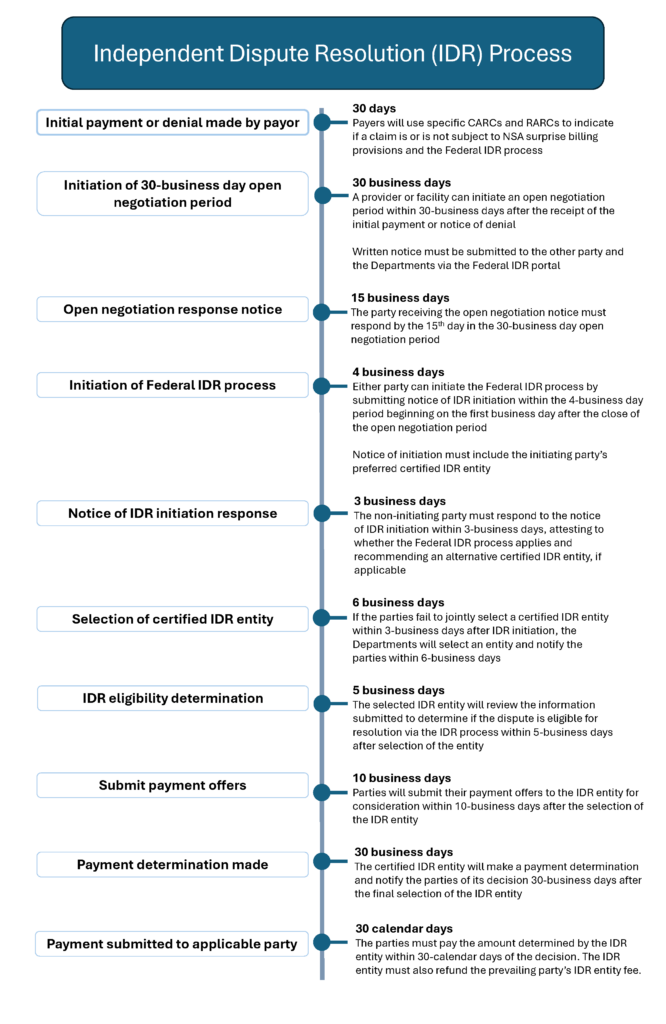
Operations

The Departments issued a Final IDR Operations Rule in May 2026 that introduces the IDR Gateway, a single platform where users can manage disputes, track the status of a case and manage activity. This platform will be operational by the end of 2026 and will be used to start and respond to disputes, access dispute dashboards and reports associated with their organization, track dispute information, monitor assigned disputes by process phase and review notifications regarding dispute activity. This platform also will be used to initiate the open negotiation process. 

The Final Rule requires payers subject to the Federal IDR process to register with the Departments and provide certain general information to verify status and contact information. Upon registry, a plan or issuer will receive an IDR registration number. Parties engaging in the IDR processes will have access to the relevant registration number through the required disclosures and may access the associated registration information through the Federal IDR portal, which is expected to be released on the CMS website by end of 2026. Plans and issuers also will be required to update the information in the registry within 30 days of any changes, confirm annually that the registration information is accurate and ensure third party administrators clearly identify the plans they represent.  

Independent Dispute Resolution Process

The federal IDR process under the NSA serves as the second part of a formal mechanism for resolving payment disputes between providers and payers over out-of-network rates through an independent arbitrator. Parties use this process when open negotiations fail to result in an agreement on payment amount for certain NSA-protected services. 

The 30-business-day open negotiation period is a required step before initiating arbitration. This period does not prevent disputing parties from settling an agreement sooner or from continuing discussions past 30 days. However, if no agreement is reached, both parties must exhaust the open negotiation period before proceeding to IDR. 

  • After the 30-business-day negotiation period, disputing parties have four business days to initiate the arbitration process. 
  • Arbitration can be initiated by either party, but must be done by submitting a written notice to the non-initiating party and to the Departments during the four-business-day period beginning on the first business day after the last day of the open negotiation period. 
  • The non-initiating party must provide a response to the notice of IDR initiation to the Departments and to the initiating party through the Federal portal within three business days after the date of IDR initiation. 

Note: CMS finalized the Federal Independent Dispute Resolution Operations rule on May 28, 2026. Guidance on many provisions related to the open negotiations and Independent Dispute Resolution process is forthcoming. OMSs are encouraged to monitor CMS.gov for NSA updates. 

A notice of IDR initiation must include: 

  • Information sufficient to identify the provider, facility or provider of air ambulance services, including the name, current contact information and the NPI; and if the initiating party is a provider, facility or provider of air ambulance services, the Tax Identification Number (TIN) 
  • Information sufficient to identify the plan or issuer, including the IDR registration number, the legal business name and the current contact information provided with the initial payment or notice of denial of payment; if the initiating party is a plan or issuer, the plan type and TIN 
  • The name and contact information for any third party representing the initiating party, along with an attestation that the third party has the authority to act on behalf of the party it represents in the Federal IDR process 
  • Information sufficient to identify whether the dispute being initiated includes batched or bundled qualified IDR items or services 
  • Information sufficient to identify the items/services with dates of service, procedure/service code, place of service, type of service (e.g., emergency vs. non-emergency, professional or facility-based) and state where items/services were furnishedThe initial payment amount (including $0 if payment is denied) 
  • If the initiating party is a plan or issuer, patient-cost sharing 
  • The qualifying payment amount, if provided with the initial payment or notice of denial of payment or if the initiating party is a plan or issuer 
  • If the initiating party is a provider or facility, a statement that items and services do not qualify for the notice and consent exception 
  • A statement that the provider, facility or provider of air ambulance services was nonparticipating on the date the item or service was furnished 
  • An attestation that the items and services under dispute are qualified IDR items or services 
  • A copy of the initial payment or notice of denial of payment or other remittance advice 
  • Preferred certified IDR entity 

New Federal IDR Operations rules require the non-initiating party to submit written notice and supporting documentation to the initiating party and the Departments within three business days after the date of IDR initiation, in response to the notice of IDR initiation. The responding party must provide the same elements of the IDR initiation notice, with additional statements and documentation needed to confirm or deny the accuracy of information submitted in the initiation notice. If the responding party objects to the initiating party’s preferred certified IDR entity, the notice of IDR initiation response must include the name of an alternative preferred certified IDR entity and, if applicable, an explanation of any conflict of interest with the initiating party’s preferred certified IDR entity.  

Following the initiation of the Federal IDR process, parties have three business days to jointly select a certified IDR entity. 

A non-initiating party would be required to agree or object to the preferred certified IDR entity in its notice of IDR initiation response within three business days after the date of IDR initiation. If the non-initiating party agrees, or fails to object, to the selection of the initiating party’s preferred certified IDR entity, the preferred certified IDR entity will be considered jointly selected by the parties.  

If the non-initiating party objects to the selection of the initiating party’s preferred certified IDR entity by designating an alternative preferred certified IDR entity in its notice of IDR initiation response within the three-business-day timeframe, the initiating party would be required to agree or object to the alternative preferred certified IDR entity using the notice of certified IDR entity selection. If the initiating party agrees to the alternative preferred certified entity within three business days after initiation, or if the non-initiating party submits the notice of IDR initiation response on or before the second business day after the date of IDR initiation and the initiating party fails to respond within three business days after the date of IDR initiation, the alternative preferred certified IDR entity would be considered jointly selected by the parties.  

However, if the non-initiating party submits the notice of IDR initiation response on the third business day after the date of IDR initiation and the initiating party does not agree on the same date, the parties will have failed to jointly select a certified IDR entity. 

In the event disputing parties fail to jointly select a certified IDR entity, the Departments will randomly select an entity, and both parties will be notified of the selection no later than six business days after IDR initiation. 

The dispute resolution process is specific to situations where the qualifying payment amount (QPA) is applied as the out-of-network payment rate. In cases where an all-payer agreement exists or specified state laws are in place to determine out-of-network rates and handle disputes, the NSA dispute resolution process does not apply. Also, services for which a notice and consent waiver was utilized, as permitted under the NSA, are not eligible for the federal dispute process. 

CMS developed several resources to aid providers in determining whether the federal arbitration process, state law or all-payer agreement applies for determining out-of-network payment rates: 

The final IDR Operations rule released in May 2026 requires certified IDR entities to determine eligibility within five business days of final certified IDR entity selection and notify both disputing parties and the Departments. Parties also are required to submit additional information to support eligibility determination to the certified IDR entity within five days of a request from the entity. If a party fails to provide the requested information, the IDR entity will proceed with its determination without the requested information, if possible. If it is not possible to proceed, the IDR entity will close the dispute. 

Batching disputes 

Initiating parties are permitted to include multiple items or services as separate payment determinations in a single dispute, referred to as a “batched dispute.” The final IDR Operations rule released in May 2026 finalizes that qualified IDR items and services may be batched under the following circumstances: 

  • Items and services are furnished to a single patient on the same or consecutive dates of service, and billed on the same claim form 
  • Items and services are furnished to one or more patients and are billed under the same service code or a comparable code under a different procedural code system (e.g., CPT and HCPCS) 
  • Anesthesiology, radiology, pathology and laboratory items and services that are furnished to one or more patients under service codes belonging to the same Category I CPT code section, as specified in guidance by the Departments 

Parties are limited to batched determinations of up to 50 qualified IDR items and services in a single dispute to ensure that certified IDR entities can make timely eligibility and payment determinations. Batched determinations also have a shortened cooling-off period of 30 business days.  

Bundling disputes 

The Department finalized a definition of a “bundled payment arrangement” to distinguish it from a batched dispute scenario in the final IDR Operations rule. A bundled payment arrangement exists when: 

  • A provider, facility or provider of air ambulance services bills for multiple items or services furnished to a single patient under a single service code that represents multiple items or services (e.g., diagnostic-related group codes). 
  • A plan or issuer makes an initial payment or notice of denial of payment to a provider, facility or provider of air ambulance services under a single service code that represents multiple items or services furnished to a single patient. 

Effective Aug. 3, 2026, bundled payment arrangements are no longer subject to the rules for batched disputes. 

Note: CMS released the Federal Independent Dispute Resolution Operations rule on May 28, 2026. Guidance on many provisions related to the open negotiations and Independent Dispute Resolution process is forthcoming. OMSs are encouraged to monitor CMS.gov for NSA updates. 

Parties will submit their payment offers to the IDR entity for consideration within 10 business days after the selection of the IDR entity. 

In determining payment amounts, arbitrators must consider the QPA, as well as other factors such as the provider’s level of training and experience, patient acuity, service complexity, facility characteristics (e.g., teaching status, case mix, scope of services) and good-faith efforts (or lack thereof) made by the provider or plan to establish network agreements. 

Arbitrators may not consider certain factors such as usual and customary charges, potential out-of-network charges (i.e., the amount that could have been billed without the NSA’s balance-billing protections) and public payer rates from programs like Medicare, Medicaid and TRICARE. 

The IDR entity will make a payment determination and notify the parties of its decision 30 business days after the final selection of the IDR entity. The IDR entity’s decision is binding, and payment must be made within 30 calendar days from the date of payment determination, when applicable. The IDR entity also must refund the prevailing party’s IDR entity fee. 

The final Independent Dispute Resolution Operations rule established four conditions when a withdrawal of a dispute may be permitted: 

  • The initiating party submits a notification that outlines and confirms the agreement and signatures of both parties. 
  • The initiating party submits a request to withdraw, and the other party either submits a response in agreement or fails to respond within five business days of the request. 
  • The Departments/IDR entity cannot determine eligibility because both parties are unresponsive to requests for additional information. 
  • The IDR entity cannot make a payment determination because neither party submitted an offer. 
QUICK
LINKS